What if you could own a property in an international real estate market, generate rental income, and continue living wherever you choose?
For investors in the United States, Canada, and other international markets, Panama offers an opportunity worth exploring: purchasing real estate for rental income without making the country their permanent residence.
Panama attracts international attention for its US dollar-based economy, established urban infrastructure, international connectivity, and diverse residential property market. Depending on the location, property type, purchase price, and rental strategy, investors may be able to generate income from tenants while building a long-term real estate portfolio.
You do not necessarily need to live in Panama to own and rent out a property there. With appropriate local professional support, many ownership and rental-management tasks can be handled remotely.
However, a successful investment requires more than purchasing an attractive apartment. Investors must understand rental demand, acquisition costs, property management, taxes, vacancy risk, and the difference between gross rental yield and actual net returns.
In this guide, All About Panamá explores what foreign investors should know before buying property in Panama for rental income, how remote ownership can work, and how to evaluate a potential investment.
1. Why Consider Panama for a Rental Property Investment?
Panama can appeal to international real estate investors for several reasons.
A US dollar-based economy
Panama uses the US dollar for everyday transactions alongside the balboa, which maintains parity with the dollar.
For investors whose capital and financial planning are already denominated in US dollars, this can simplify the purchase process, rental-income calculations, and ongoing expense management.
It does not eliminate every financial risk, however. Property values, interest rates, operating expenses, tenant demand, and exchange rates involving other currencies can still affect the investment.
An established international business environment
Panama City is an important regional business and transportation center. Its residential market serves a variety of potential tenants, including local professionals, corporate employees, international residents, and people relocating for work.
Demand varies by neighborhood, property type, price point, and economic conditions. Investors should therefore evaluate the tenant profile of a specific property rather than assuming that every area will generate consistent rental income.
Different property investment strategies
Panama offers several potential approaches to rental property ownership. Investors may consider: long-term residential rentals for tenants seeking a primary residence; furnished apartments for tenants with temporary professional or relocation needs, where permitted; properties in residential communities with access to employment centers and essential services; and select vacation-oriented properties where local regulations and the building’s rules permit the intended rental activity.
Each strategy has different operating requirements, costs, and risks. Long-term residential rentals may provide a more predictable management structure, while short-term rentals can require more frequent guest turnover, furnishing, cleaning, marketing, and regulatory compliance.
The appropriate strategy depends on your investment goals, available capital, and willingness to manage operational complexity.
2. What Rental Returns Can Investors Expect in Panama?
One of the first questions foreign investors ask is how much rental income a property can generate. The answer depends on the acquisition price, achievable rent, location, building expenses, occupancy, and property-management costs.
As a market reference, Global Property Guide reported an average gross residential rental yield of approximately 7.40% for Panama as of its most recently published update (Q4 2026), based on asking rents and asking prices. This is a historical market estimate, not a guaranteed return or a forecast for any individual property, and it moves from quarter to quarter.
Source: Global Property Guide — Rental Yields in Panama.
Understanding gross rental yield
Gross rental yield is a simple way to compare potential rental income against a property’s purchase price. The formula is: Gross rental yield = Annual rental income ÷ Property purchase price × 100.
For example, suppose you purchase an apartment for $200,000 and rent it for $1,200 per month. Purchase price: $200,000. Monthly rent: $1,200. Annual rental income: $14,400. Gross rental yield: 7.2%.
This example is illustrative. It does not represent a guaranteed market rent or the expected return of a specific property.
Gross yield is not net profit
The calculation above does not account for expenses. Your actual return will depend on the costs of owning and operating the property, which may include: condominium or homeowners’ association fees; property management fees; maintenance and repairs; insurance; applicable property taxes; vacancy periods and unpaid rent; furnishing and replacement costs, where relevant; financing costs, if you use a mortgage; and applicable income taxes and professional fees.
For this reason, two apartments with the same gross rental yield can produce very different financial results. The goal should not be to find the property with the highest advertised yield. It should be to identify an investment that offers an acceptable net return for its level of risk.
3. Can You Buy Property in Panama Without Living There?
Yes. Foreign investors can generally purchase real estate in Panama without becoming residents or relocating to the country. The acquisition process and any applicable restrictions should be verified for the particular property and the buyer’s circumstances. Special rules may apply to certain types of land or locations.
For investors who live abroad, the key is to establish a reliable local structure for the purchase and ongoing administration.
What does remote property ownership involve?
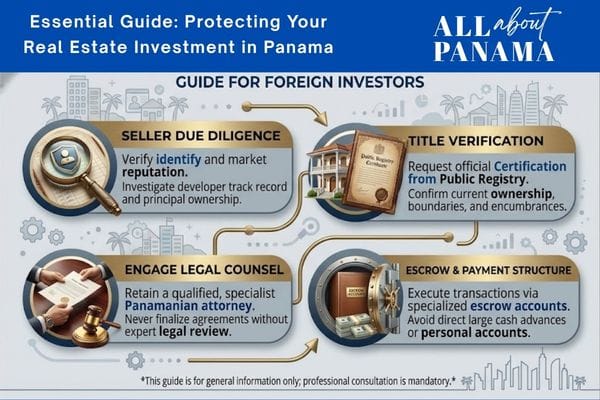
A typical remote ownership arrangement may include: selecting a property based on investment objectives and verified market information; appointing a qualified local real estate professional to help evaluate available properties; hiring an independent Panamanian lawyer to conduct legal due diligence and review transaction documents; confirming the title, applicable restrictions, building documentation, and outstanding obligations; arranging payment and completing the acquisition through appropriate legal procedures; and engaging a property manager to coordinate tenants, rent collection, maintenance, and reporting.
The precise steps depend on the transaction and should be confirmed with your lawyer.
Do you need to visit Panama before buying?
A visit can be useful because it allows you to inspect properties, understand neighborhoods, and evaluate the local market firsthand. However, travel is not necessarily required for every stage of a transaction. Some tasks may be handled through authorized local representatives, subject to legal requirements, identity verification, and the procedures of the parties involved.
If you are unable to visit, independent legal representation, documented property inspections, reliable financial controls, and careful verification become especially important. Do not rely solely on promotional material, virtual tours, or a seller’s rental projections when committing a substantial amount of capital.
4. How to Manage a Rental Property in Panama From Abroad
Remote ownership is more practical when the operational responsibilities are assigned to reliable local professionals. A property manager can act as your local point of contact while you remain in the United States, Canada, or another country.
Depending on the service agreement, management responsibilities may include: advertising the property and coordinating viewings; screening prospective tenants; preparing or coordinating lease documentation; collecting rent and following up on late payments; coordinating repairs and routine maintenance; communicating with the building administration; providing financial statements and expense reports; and managing tenant move-in and move-out procedures.
The exact scope of service varies by provider. Some managers offer full-service administration, while others provide only selected services.
What should you look for in a property manager?
Before hiring a manager, ask: What is the management fee, and how is it calculated? Are tenant placement and lease renewal charged separately? How are maintenance expenses approved? Is there a spending limit for repairs without prior authorization? How frequently will you receive financial statements? How are rent payments transferred to you? What procedures apply to tenant screening and arrears? Does the company have experience with foreign owners? What happens if the property remains vacant?
Request a written agreement that defines responsibilities, fees, reporting frequency, and authorization limits.
Build a reporting system from the beginning
For an investor living abroad, financial visibility is essential. Ask for monthly or quarterly reporting that shows rent collected, management fees, maintenance expenses, taxes paid, vacancies, and the property’s operating balance.
Keep invoices, contracts, payment confirmations, and tax records organized. This helps you evaluate performance and makes it easier for your accountant to review the investment. Remote ownership can reduce the need for your physical presence, but it does not eliminate your responsibility to monitor the asset.
5. Which Areas of Panama Should Rental Property Investors Consider?
The best location depends on the intended tenant, purchase budget, rental strategy, and expected holding period. Rather than selecting a property simply because an area is popular, investigate where demand for the type of rental you plan to offer is most relevant.
Panama City: Residential and professional rental demand
Panama City is worth evaluating for investors interested in residential properties near employment centers, transportation, shopping, healthcare, and other urban amenities. Different neighborhoods attract different tenant profiles, and rental prices can vary considerably even within the same district.
When comparing apartments, consider: distance to major employment centers; access to public transportation and main roads; nearby supermarkets, restaurants, and healthcare facilities; the building’s age, maintenance, amenities, and reputation; the number of comparable apartments available for rent; and recent achievable rents rather than only advertised asking prices.
Areas frequently evaluated by residential investors include San Francisco, Bella Vista, Obarrio, El Cangrejo, and Costa del Este. These neighborhoods should not be treated as interchangeable: acquisition costs, tenant profiles, expenses, and potential returns differ.
Beach and resort-oriented markets
Coastal locations may appeal to investors interested in furnished rentals, second-home demand, or longer-term residents seeking a beach-oriented lifestyle. However, tourism activity does not automatically translate into attractive investment returns.
Before purchasing, investigate seasonal demand, annual occupancy, local services, property maintenance, insurance, and access to transportation. You must also confirm that the intended rental model is permitted by applicable laws, municipal requirements, and the property’s condominium rules.
Emerging or lower-cost locations
Some investors explore locations outside the most established residential districts to seek a lower purchase price or a different tenant market. A lower entry price is not sufficient evidence of a good investment. If tenant demand is limited, a cheaper apartment may remain vacant longer or require lower rent than expected.
Evaluate comparable rental transactions, supply of competing properties, local infrastructure, and realistic resale prospects before committing capital.
6. Long-Term Rentals vs. Short-Term Rentals: Which Strategy Is Better?
There is no universally superior rental model. The right choice depends on your priorities and the property’s characteristics.
Long-term residential rentals
Long-term rentals may suit investors who want a relatively straightforward operating structure. Potential advantages include longer lease periods, less frequent tenant turnover, reduced need for guest services and frequent cleaning, and more predictable rental arrangements when tenants pay consistently.
Potential disadvantages include vacancies between leases, tenant-related risks, maintenance responsibilities, and the possibility that market rents will change over time. A long-term lease is not a guarantee of uninterrupted income. Screening tenants and preparing appropriate legal agreements remain important.
Short-term and vacation rentals
Short-term rentals may offer different revenue opportunities in locations with suitable visitor demand. However, they can involve more complex operations, including guest communication, check-in arrangements, cleaning, furnishings, utilities, booking platform fees, and frequent maintenance.
Investors must also verify the legal framework before choosing this strategy. Panama’s rules for tourist lodging and short stays can differ from those for ordinary residential leases. Building regulations may impose additional restrictions. Do not assume that every apartment can legally be operated as an Airbnb or other short-term rental simply because the owner has purchased it.
How should you choose?
Compare both strategies using realistic assumptions for annual occupancy, average rent or nightly rate, management and platform fees, cleaning, utilities and maintenance, insurance and taxes, vacancy periods, initial furnishing and setup costs, and applicable legal and building requirements. A higher advertised nightly rate does not necessarily translate into a higher annual net return.
7. The Real Costs of Buying a Rental Property in Panama
One of the most common investment mistakes is evaluating a property only by its advertised purchase price. To estimate the total investment, account for acquisition costs, operating expenses, and a reserve for unexpected events.
Acquisition costs
Depending on the transaction, these may include legal fees, registration-related expenses, applicable transfer taxes or other transaction charges, due diligence, and costs associated with financing. The exact amounts depend on the property, transaction structure, and applicable law. Ask an independent lawyer to provide an itemized estimate before signing.
Recurring ownership costs
Once you own the property, expenses may include condominium fees, property insurance, maintenance and repairs, property management, property taxes where applicable, accounting and tax-compliance costs, utilities paid by the owner, and costs incurred during vacancy periods.
The Panamanian tax authority, the Dirección General de Ingresos (DGI), provides official information about property taxes and rental-related tax matters. Consult the DGI official portal and a qualified local tax professional to determine how the rules apply to your property and personal circumstances.
Example: Estimating a more realistic rental return
Suppose you purchase an apartment for $200,000 and expect to collect $14,400 in annual rent.
| Item | Illustrative annual amount |
|---|---|
| Gross rental income | $14,400 |
| Property management | $1,152 |
| Condominium fees | $2,400 |
| Maintenance reserve | $600 |
| Vacancy allowance | $720 |
| Insurance and applicable property taxes | $800 |
| Estimated operating income before income tax and financing | $8,728 |
In this illustration, the listed expenses total $5,672, leaving $8,728 before income tax, financing costs, and any additional expenses not included in the example. The resulting yield on the $200,000 purchase price would be approximately 4.36% before those additional costs.
These figures are hypothetical and are not a market quotation or an estimate for a specific property. Actual expenses, taxes, rent, and vacancy rates must be verified individually. The example also excludes acquisition costs, which would increase the total amount invested and affect the return on total capital. The purpose is to show why a gross yield should never be confused with the money an owner ultimately retains.
8. Tax Considerations for Foreign Property Owners
Owning rental property in another country introduces tax and reporting responsibilities that should be understood before investing. The relevant treatment may depend on the type of property, the rental arrangement, deductible expenses, ownership structure, the investor’s tax residence, and the tax laws of the countries involved.
Understand Panamanian obligations
A foreign owner should establish whether local tax registration, filings, payments, or other compliance steps apply to the property and rental income. Property-related taxes and rental-income taxation are separate matters, and their treatment can differ according to the circumstances. Do not assume that all rental income is tax-free or that all ownership expenses are deductible. Have a Panamanian tax professional assess the applicable rules before calculating your expected net return.
Consider your home country’s tax rules
If you are a US citizen, Canadian resident, or tax resident of another country, you may also have reporting obligations in your home jurisdiction. Owning property overseas does not automatically remove those obligations. Before purchasing, speak with a tax adviser who understands both the Panamanian rules and the rules that apply to your personal situation.
9. Key Risks Foreign Investors Should Evaluate
Vacancy risk
If a property remains unoccupied, rental income may fall below expectations while ownership expenses continue. Review comparable properties, realistic tenant demand, and the time required to find a new tenant.
Market and resale risk
Property prices do not always rise. Some buildings or neighborhoods may experience slower demand, increased competition, or lower resale values. Assess the property based on its current fundamentals rather than assuming future appreciation will compensate for a weak rental return.
Building and maintenance risk
Unexpected repairs, building assessments, infrastructure problems, or increases in condominium fees can reduce profitability. Review building records, maintenance history, financial statements where available, and any planned major works before purchasing.
Tenant and management risk
Late payments, disputes, property damage, and ineffective management can affect the investment. Use appropriate tenant-screening procedures, clear lease documentation, and a reliable system for reporting and resolving issues.
Legal and regulatory risk
Ownership, rental arrangements, zoning, and short-term accommodation rules can affect how a property may be used. Obtain independent legal advice and verify the permitted rental use before completing the purchase. A disciplined investor evaluates these risks before committing capital, not after a problem occurs.
10. A Step-by-Step Strategy for Investing in Panama From Abroad
Step 1: Define your investment objective. Decide whether you prioritize recurring rental income, long-term capital appreciation, future personal use, or a combination of these goals.
Step 2: Set your total investment budget. Include the purchase price, transaction costs, initial repairs, furnishings if required, and a reserve for vacancies and unexpected expenses.
Step 3: Research the tenant market. Identify the type of tenant you want to serve and examine comparable properties and achievable rents in the relevant area.
Step 4: Calculate gross and net yields. Compare properties using the same assumptions for rent, vacancy, management, taxes, insurance, and maintenance.
Step 5: Conduct independent due diligence. Have a qualified Panamanian lawyer review the title, ownership records, transaction documents, applicable restrictions, and other relevant matters.
Step 6: Establish local management. Interview property managers, compare service agreements, and define reporting and expense-approval procedures.
Step 7: Confirm tax and compliance requirements. Consult a qualified tax professional about local obligations and any reporting requirements in your country of residence.
Step 8: Monitor the investment. Review rent collection, occupancy, expenses, maintenance, and net performance regularly.
11. Does Buying Property in Panama Automatically Grant Residency?
No. Purchasing property for rental income does not automatically grant residency in Panama. Panama has immigration categories for certain investors who satisfy specific investment, documentation, and legal requirements. Eligibility depends on the applicable program and the circumstances of the investment.
If obtaining residency is also one of your objectives, confirm the current rules with the National Migration Service of Panama and consult qualified immigration counsel. Do not assume that a property purchased for rental income qualifies for a particular residence permit or that ownership alone is sufficient.
12. Is Panama Real Estate a Good Fit for Your Investment Portfolio?
Panama real estate may be worth evaluating if you want to diversify your assets geographically and are comfortable with the responsibilities of owning property abroad. It may appeal to investors who have capital available for a medium- or long-term investment, want to evaluate rental income as one component of their investment strategy, prefer to work with local professionals rather than manage tenants personally, understand that returns vary by property, location, expenses, and market conditions, are prepared to conduct independent legal and financial due diligence, and can tolerate periods of vacancy and unexpected ownership costs.
It may be less suitable for investors who need guaranteed monthly income, require immediate liquidity, or cannot absorb unexpected expenses. Real estate is relatively illiquid compared with some financial investments. Selling a property can take time, and transaction costs can affect the amount ultimately recovered.
Frequently Asked Questions About Buying Rental Property in Panama
Can foreigners buy property in Panama?
Foreigners can generally purchase real estate in Panama, subject to applicable legal restrictions and the characteristics of the property. Obtain independent legal advice to verify title, ownership, and any relevant limitations before completing a transaction.
Can I rent out a property in Panama without living there?
Yes. Foreign owners can generally rent out eligible properties without residing in Panama. They can appoint a local property manager to coordinate tenants, rent collection, maintenance, and reporting, subject to the applicable rules and the terms of the management agreement.
What rental yield can I expect from a property in Panama?
Rental yields vary by location, property type, purchase price, and achievable rent. Published market estimates can provide a reference point, but gross yield is not net profit. Calculate your expected return after management fees, vacancy, maintenance, taxes, insurance, and other expenses.
Is Panama suitable for passive real estate income?
Panama may offer opportunities for investors seeking rental income, but owning property is not entirely passive. Even with a property manager, owners must monitor expenses, approve significant repairs, review performance, and meet applicable legal and tax obligations.
Should I choose long-term or short-term rentals?
The best strategy depends on tenant demand, property location, operating costs, applicable regulations, and your investment objectives. Long-term rentals may offer a simpler operating structure, while short-term rentals may involve more intensive management. Verify that the intended rental activity is legally permitted before buying.
What expenses should I include when calculating rental profitability?
Consider acquisition costs, condominium fees, property management, maintenance, repairs, insurance, taxes, vacancy, financing, and other relevant operating expenses. Include initial setup costs and evaluate your return against the total capital invested.
Do I need to visit Panama to purchase a property?
A visit can help you inspect the property and understand the market. Some parts of the transaction may be handled remotely through authorized representatives, subject to legal and procedural requirements. Independent due diligence is particularly important when you cannot inspect the property personally.
Does buying a rental property in Panama grant residency?
Not automatically. Certain investment-related immigration pathways have specific requirements, and property ownership alone does not guarantee eligibility. Confirm the applicable program with Panama’s immigration authorities and qualified legal counsel.
Conclusion: Invest in Panama Real Estate With a Clear Strategy
Buying property in Panama to generate rental income can be an opportunity for foreign investors who want to explore international real estate without relocating. The country’s dollar-based economy, varied residential markets, and access to local property-management services make remote ownership worth considering. However, the outcome depends on the specific investment, not simply on choosing Panama as a destination.
A well-informed decision starts with realistic rental assumptions, careful due diligence, a clear understanding of operating costs, and reliable local support. The most attractive property is not necessarily the one with the highest advertised rental yield. It is the one whose realistic net returns, risks, and long-term prospects fit your investment objectives.
At All About Panamá, we help international readers explore the practical considerations of living and investing in Panama. If you are considering purchasing a property for rental income, begin by researching the market, comparing potential returns, and identifying the right professional support for your investment.
Explore Panama. Evaluate the numbers. Invest with a plan.
Related reading: Cost of Living in Panama vs. Other Latin American Capitals, Is Panama a Good Place to Retire in 2026?, and Panama Residency: Alternatives to the $500,000 Investment Requirement.
Disclaimer: This article is for general informational purposes only and does not constitute legal, tax, financial, or investment advice. Rental yields and property values can change, and rental income is not guaranteed. Verify current market information and applicable laws with qualified professionals before making an investment.
Thinking about a property investment in Panama? Discover Altos del María, a planned mountain community just an hour from Panama City, offering a well-managed alternative to coastal and city-center investments.